

Reviewed · WALKING TOURS
Chicago Riverwalk Self-Guided Walking Tour
If you like your Chicago stories on the move, this helps. This self-guided audio walking tour turns the Riverwalk into a route you can follow at your own pace, from big architecture to quieter memorials. And because the guide uses location cues, your phone basically does the timing for you.
I especially like the offline GPS maps and location-based audio. You can keep walking even if you lose signal, and the stories play hands-free as you reach each stop. I also like that the pass is new, lifetime access, no expiry, so you can reuse it on future trips without paying again.
One possible drawback: you must download the tour while you have strong Wi-Fi or cellular, and you’ll get the smoothest experience if you bring headphones and stick close to the intended route. If your phone GPS is spotty, audio timing can feel less perfect.
In This Review
- Key things that make this Riverwalk audio tour worth your time
- Riverwalk Stories on Autopilot, Without Waiting for a Group
- Starting Point and Route Basics on the Chicago Riverwalk
- Tech Check: Download Once, Then Rely on Offline GPS Maps
- Stop 1: Wrigley Building, Gum Fortune, and a Clock Tower Moment
- Stop 2: Michigan Avenue Bridge and the DuSable Bridge Flag Stories
- Stop 3: 401 N Wabash Ave, Tower Height, and a Construction Technique Connection
- Stop 4: Vietnam Veterans Memorial, a Quiet Pause in a Busy Area
- Stop 5: Marina Towers, a City Inside a City
- Stop 6: Dearborn Street Bridge and How Residents Changed the Plan
- Stop 7: 325 N La Salle Dr, Encyclopedia Britannica Headquarters Since 1914
- Stop 8: Merchandise Mart, Art Deco Scale With Its Own Zip Code
- Stop 9: McCormick Bridgehouse and Chicago River Museum Views Above the Water
- Stop 10: Tribune Tower, Neo-Gothic Details and a Competition Backstory
- Stop 11: William P. Fahey Bridge, Columbus Drive, and How Chicago Built Differently Over Time
- Stop 12: NBC Tower, Art Deco Style and Famous Recording Roots
- Price and Value: Is $14.99 Fair for This Kind of Walk?
- Who Should Book This Chicago Riverwalk Self-Guided Tour
- Should You Book This Chicago Riverwalk Audio Tour?
- FAQ
- How long is the Chicago Riverwalk self-guided walking tour?
- Where does the tour start and where does it end?
- Is the audio tour hands-free?
- Does it work offline?
- What language is the tour available in?
- Is the cost per person, and what is included in the price?
- How do I access the tour on my phone?
- What phone types are recommended?
- What if I need to cancel?
Key things that make this Riverwalk audio tour worth your time
- Offline GPS navigation, so you can keep moving without relying on signal
- Hands-free audio that plays automatically as you reach each story point
- Lifetime access with no expiry, useful if you plan repeat visits to Chicago
- English narration with a set route from 99 Chicago Riverwalk to River Esplanade
- A stop-by-stop mix of architecture, bridges, and a Vietnam memorial
- Short visits per stop (about five minutes each), with plenty of room to linger
Explore Chicago on your own clock
Riverwalk Stories on Autopilot, Without Waiting for a Group
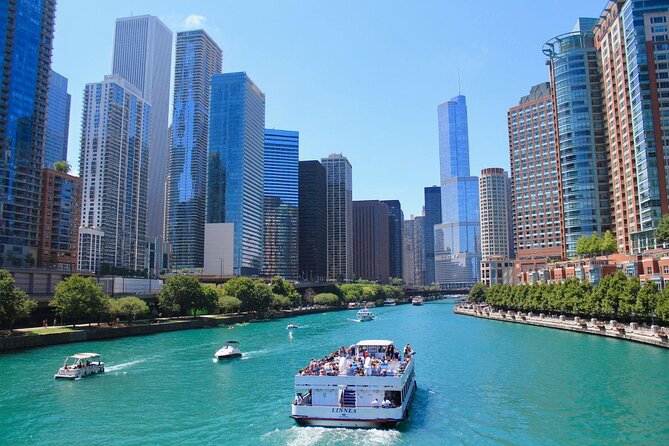
This tour is built for independent pacing. You start at the beginning of the route, open the app onsite, and the first story starts automatically when you’re at the right place. Then the narration keeps going based on your location, so you are not constantly tapping for the next audio clip.
For me, the best part is how it keeps you from staring at your phone. With headphones in, you get the next story when you arrive, and you can focus on what is in front of you, not what is on your screen. If you enjoy architecture and city design, that matters because you’ll naturally look up more.
Starting Point and Route Basics on the Chicago Riverwalk
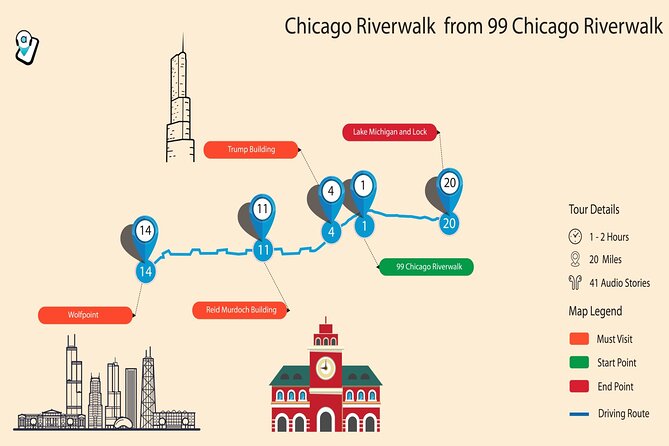
The tour starts at 99 Chicago Riverwalk and ends at River Esplanade. It runs about 1 to 2 hours depending on how long you pause for photos and side looks. The route is designed so each main stop is roughly five minutes, which is a nice rhythm if you like steady momentum.
You also get flexibility. You can start when you arrive, pause whenever you want a break, and restart later during the same walk if you take a detour. It is also described as a private activity, meaning your group is the only one participating, even though you are still self-guided.
Tech Check: Download Once, Then Rely on Offline GPS Maps
You will need the Action’s Tour Guide App to run the audio. After booking, you get an email and text with setup instructions and a password, and you are told to search for audio tour in those messages.
Here is the practical rule that makes or breaks the experience: you must download the tour while you have strong Wi-Fi or cellular. After that, it works offline. The tour also uses offline GPS maps, so you are not stuck if your signal drops while you are walking.
Device requirements are spelled out too. The recommended setup is an iPhone with iOS 15 or later, an Android device running version 9 or later, or an iPad/tablet with GPS and cellular connectivity.
Tip: pack your earbuds and do the download before you head out. Once you start walking, you want your phone to be a guide, not a troubleshooting hotline.
Stop 1: Wrigley Building, Gum Fortune, and a Clock Tower Moment
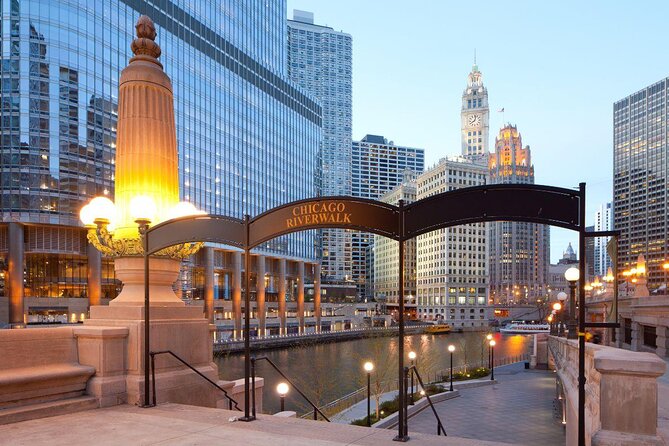
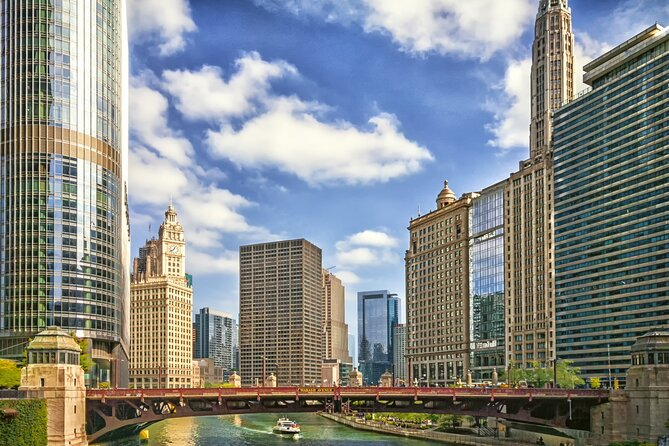
You begin at the Wrigley Building, the terra cotta landmark with a huge clock tower and plenty of character. The story connects the name to William Wrigley, Jr., famous for making his fortune from chewing gum. That one detail turns the building from a pretty facade into a clue about who helped shape Chicago’s business world.
What I like about this stop is the way it sets the tone for the whole walk. The Wrigley Building is not just a photo, it is a kickoff into how Chicago got its identity through industry, design, and attention to detail.
You also get a mention of Hotel InterContinental, with an incredible observatory inside. Since the tour does not promise entry tickets, treat that as an extra you might explore later if you want a closer look.
Stop 2: Michigan Avenue Bridge and the DuSable Bridge Flag Stories
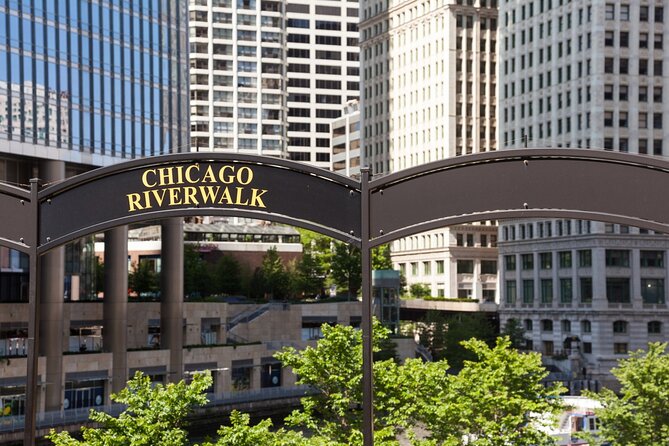
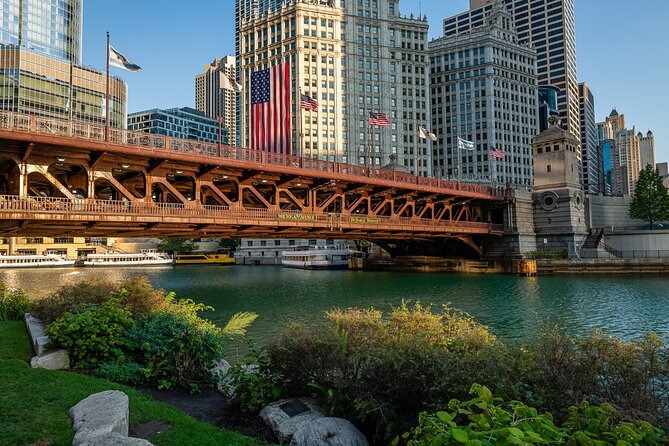
Next up is the Michigan Avenue Bridge, also known as the DuSable Bridge. You are meant to notice the architecture, but the audio also nudges you to look at the flags and learn their history.
This is one of those stops where you can slow down without feeling like you are wasting time. Bridges are perfect “listen while you look” spots because the structures frame the river and skyline. If you pause for a photo here, the narration should still feel timed to your view.
A few more ways to spend a day in Chicago
- Chicago: Gangsters and Ghosts Walking Tour★ 5.0 · 7,155 reviews
- Chicago Favorites Ultimate Food and Walking Tour★ 5.0 · 1,962 reviews
- Chicago: Gangsters and Ghosts Guided Walking Tour★ 4.7 · 1,697 reviews
- Chicago in a Day: Food, History & Architecture Walking Tour★ 5.0 · 1,153 reviews
- Chicago’s Secret Interiors Architectural Walking Tour★ 5.0 · 635 reviews
Stop 3: 401 N Wabash Ave, Tower Height, and a Construction Technique Connection
At 401 N Wabash Ave, you face an enormous glass tower. The guide gives you real scale, describing it as 1,399 feet tall and 98 stories, placing it among the tallest skyscrapers in the country.
What I appreciate is the connection to engineering world history. The tower is described as using the same building technique as the Burj Khalifa in Dubai, the current tallest building in the world. Even if you are not a construction nerd, that comparison helps your brain understand why Chicago’s skyline looks the way it does.
Stop 4: Vietnam Veterans Memorial, a Quiet Pause in a Busy Area
Not every stop here is about height and glass. The Vietnam Veterans Memorial features a sunken rectangular pool and fountain, honoring Illinois residents who died in the Vietnam War.
This stop is somber, and the tour frame makes it feel respectfully so. It is also a helpful pacing break. After skyscrapers and bridges, the memorial gives you a moment to reset your senses before continuing along the river.
Stop 5: Marina Towers, a City Inside a City
The Marina Towers are described with a playful comparison, looking like giant corn cobs. But the real point is what happens behind that silhouette.
The audio explains that the towers function as a “city in a city,” with an in-house theatre, gym, pool, ice-rink, bowling alley, a 360 degree roof deck, and a marina. Even if you never step inside, this is the kind of city planning detail that makes the skyline feel human-scale.
If you like neighborhoods and how people actually live in cities, this stop is a good reminder that Chicago’s icons are not only for postcards.
Stop 6: Dearborn Street Bridge and How Residents Changed the Plan
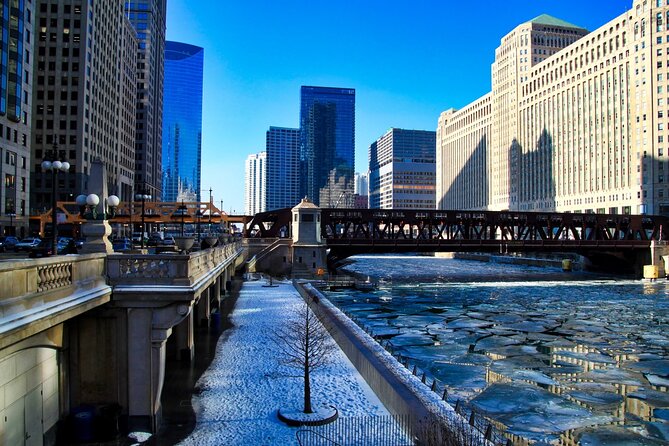
Next is the Dearborn Street Bridge, built in 1962. The tour adds a story about why it exists, explaining that it was constructed to replace a badly planned bridge residents hated.
This is useful because it shows a side of Chicago design you might otherwise miss. The bridge is not just “newer,” it is a response to public opinion and practical needs. When you look at it again after the audio, you tend to see it as a decision made by real people, not a random change in concrete.
Stop 7: 325 N La Salle Dr, Encyclopedia Britannica Headquarters Since 1914
At 325 N La Salle Dr, you get a building from 1914 that today houses the Encyclopedia Britannica headquarters. It may look short beside newer giants, and the tour prompts you to see it as a snapshot of Chicago’s past rather than a height contest.
I like stops like this because they keep the walk from turning into a skyline scoring game. If you enjoy history, this is where the tour quietly nudges you to compare eras and styles, and understand why downtown has such a mix of old and new.
Stop 8: Merchandise Mart, Art Deco Scale With Its Own Zip Code
Then it is time for the Merchandise Mart. The tour describes it as so large it has its own zip code, and it frames the building’s scale in square footage, saying it encompasses four million square feet.
It also calls out the art-deco style, which matters because this is a different visual language than the glass-and-steel tower blocks you saw earlier. If you like architectural variety, this stop is a strong one for turning “big” into something you can actually visualize.
Stop 9: McCormick Bridgehouse and Chicago River Museum Views Above the Water
The tour’s museum stop is the McCormick Bridgehouse and Chicago River Museum. It is not only about exhibits on the river and its significance to the city, it also offers a top-floor perspective with birds-eye views of the river.
Even if you do not go inside, the narration primes you to imagine the river as an organized system, not just a pretty water edge. Views help here. When you understand the river from above, the bridges and bends start making more sense.
Stop 10: Tribune Tower, Neo-Gothic Details and a Competition Backstory
The Tribune Tower brings back a strong architectural mood. The guide calls it breathtaking and neo-Gothic, and it explains it came from a competition held by the Chicago Tribune for their 75th anniversary.
You get the “why” behind the design goal too. The Tribune wanted the new headquarters to be the most beautiful and distinctive office building in the world, and the final product reflects that ambition.
This is a good stop if you like to read buildings like text. Neo-Gothic detail rewards slower looking, and the narration gives you a reason to focus on what might otherwise feel decorative.
Stop 11: William P. Fahey Bridge, Columbus Drive, and How Chicago Built Differently Over Time
Next is the William P. Fahey Bridge, also referred to as the Columbus Drive Bridge in the audio. The tour describes it as Chicago’s newest river-spanning bridge and uses it to shift from old to newer thinking.
The story is about construction technology and philosophy changing across decades. That is a clever way to keep the tour moving forward without repeating the same “look up, take photo” routine. If you pay attention here, you’ll start spotting how bridges respond to new engineering possibilities and shifting urban needs.
Stop 12: NBC Tower, Art Deco Style and Famous Recording Roots
The final stop is the NBC Tower. The audio says it was modeled after 30 Rockefeller Center in New York City, giving you a clear design lineage. It also emphasizes the art-deco style, tying the look back to the earlier downtown architecture cues.
There is another pop-culture layer too. The guide mentions it was the former recording spot of the Jerry Springer Show and the Steve Harvey Show. That kind of detail makes the tower feel less distant and more part of daily media culture.
Price and Value: Is $14.99 Fair for This Kind of Walk?
At $14.99 per person, this is positioned as a low-cost way to add depth to a route you can walk anyway. The key value driver is not just that you get audio. It is the lifetime access, no expiry, meaning you can reuse it on future Chicago trips and on repeat riverwalk walks without paying again.
The other value angle is offline use. You are not paying for entry tickets, and you do not need cellular data for the audio after download. For many visitors, that makes it a strong “use once, feel smart” purchase. If you are the type who loves architecture stories but hates guided-tour rigidity, this is a good match.
One caution: the tour does not include attraction passes or entry tickets. So if you want inside access at places you hear about, you will likely need to plan that separately.
Who Should Book This Chicago Riverwalk Self-Guided Tour
I think this fits best if you want a walking tour that is structured but still flexible. It is ideal for people who like architecture, bridges, and city planning stories, and for anyone who enjoys listening while walking instead of reading plaques.
It also suits short trips. With an estimate of 1 to 2 hours, you can slot it into a day without needing an all-morning or all-afternoon commitment. And because the app has offline support, it works well if your travel day includes patchy reception.
If you hate walking, this may feel like too much. But if you can handle a one to two hour city stroll, you should be in the sweet spot.
Should You Book This Chicago Riverwalk Audio Tour?
Book it if you want a practical way to turn the Chicago Riverwalk into a real story route. The hands-free, location-triggered audio makes the experience easy to run, and the offline GPS maps keep it reliable.
Skip it if you are looking for museum-style instruction or paid entry access. This is a walking narration experience, not a ticket bundle. Also, if you cannot reliably download on strong Wi-Fi or cellular, plan ahead so the offline version actually works when you need it.
If you do download properly, bring headphones, and follow the route at a comfortable pace, this is a solid value for a first or repeat Riverwalk visit.
FAQ
How long is the Chicago Riverwalk self-guided walking tour?
It takes about 1 to 2 hours total, depending on how long you stop and take photos or look around.
Where does the tour start and where does it end?
The start is at 99 Chicago Riverwalk and the end is at River Esplanade.
Is the audio tour hands-free?
Yes. Audio stories play automatically based on your location, so you can walk without manually starting each track.
Does it work offline?
Yes. The tour includes offline GPS maps, and it works after you download it while you have strong Wi-Fi or cellular.
What language is the tour available in?
The tour is offered in English.
Is the cost per person, and what is included in the price?
The price is $14.99 per person. Included features are the audio storytelling, offline maps, and the app experience. Attraction passes, entry tickets, and reservations are not included.
How do I access the tour on my phone?
After booking, you get an email and text with setup instructions and a password. Then you download Action’s Tour Guide App, enter the password, and start the audio from the onsite starting point.
What phone types are recommended?
It recommends an iPhone with iOS 15 or later, an Android device version 9 or later, or an iPad/tablet with GPS and cellular connectivity.
What if I need to cancel?
Cancellation is free up to 24 hours in advance for a full refund. Canceling less than 24 hours before the start time is not refunded.
Just Added





Walking Tours, compared.

Chicago Favorites Ultimate Food and Walking Tour
Read our review →
Chicago in a Day: Food, History & Architecture Walking Tour
Read our review →
Chicago’s Secret Interiors Architectural Walking Tour
Read our review →
Browse the lists this tour appears in