
Reviewed · SCAVENGER HUNTS
Eastside Chicago The Heist Exploration Game and Tour
Millennium Park turns into a game. This self-guided exploration uses your phone to lead you from one famous spot to the next, with mini challenges tied to art, architecture, and public works.
I especially like that it stays offline, so you can keep playing even if service drops while you are walking around downtown.
Second, I like the flexibility. You can start any hour, take a break, and resume later, all without coordinating with a live guide. At about 1 hour 35 minutes, it is a good add-on even on a busy day.
My main caution: downtown routes can get disrupted by construction, and some game moments depend on being in the right spot. If you get blocked or miss a required location range, you may need to use hints, and that can reduce the fun.
In This Review
- Key highlights and what matters most
- Price and format: what you’re really buying
- Where this route starts and ends (and why you should care)
- How the offline smartphone game works as a tour
- Stop-by-stop: your game route from the Art Institute to Grant Park fountains
- 1) The Art Institute of Chicago, founded in 1879
- 2) Calder’s Flying Dragon, stainless steel with red-orange energy
- 3) Crown Fountain, Jaume Plensa’s interactive video sculpture
- 4) Cloud Gate, Anish Kapoor’s reflective 110-ton sculpture
- 5) Wrigley Square and the Millennium Monument replica
- 6) Lurie Garden, layered on top of Chicago’s buried past
- 7) The Chicago Stock Exchange Arch, a surviving fragment
- 8) Buckingham Fountain, a 1927 landmark fountain moment
- 9) A contemplative Lincoln sculpture in Solti Garden
- 10) Taft’s Fountain of the Great Lakes, Benjamin F. Ferguson Fund context
- 11) Pritzker Military Museum & Library, founded in 2003
- 12) School of the Art Institute of Chicago, founded 1866, building opened 1870
- Walking comfort, timing, and how to keep the game fun
- Who this is best for (and who should look elsewhere)
- Should you book this Millennium Park heist game?
- FAQ
- How long does the Eastside Chicago The Heist Exploration Game and Tour take?
- Can I play this game without an internet connection?
- Do I need a physical tour guide?
- Where does the tour start and end?
- Is it private or shared with other groups?
- What language is the game offered in?
- What is the cancellation policy?
Key highlights and what matters most
- Offline-friendly gameplay: your smartphone game works without an internet connection.
- Start anytime, go at your pace: start and pause freely instead of racing a group schedule.
- No human contact: it is private and handled through your mobile experience.
- Iconic stops clustered close together: Millennium Park and Grant Park landmarks are within a walkable loop.
- Art and architecture clues, not trivia dumps: the challenges point your eyes at specific details and stories.
- Smartphone-first, so you need battery power: bring a charged phone to keep the game moving.
Chicago's streets, turned into a puzzle
Price and format: what you’re really buying
At $7.20 per person for roughly 1 hour 35 minutes, this feels priced for people who want a playful structure without paying for a traditional guide-led tour. That matters because Chicago’s best landmark walks are often free to enjoy in public space, but they can become random if you do not know what to look for. This game adds a simple reason to keep moving and to notice the small stuff.
You get a mobile ticket and an English experience, and the tour is always available to book with a 24/7 window. The big promise here is that it is private, with no physical guide. For me, that is a practical advantage: you are not waiting around for anyone’s questions, and you can go at a speed that fits your group.
One more practical note from the setup: you should expect a lot of walking. This is not a sit-and-watch kind of tour. Comfortable shoes are not optional here, because several stops are scattered across the Millennium Park and Grant Park area.
Where this route starts and ends (and why you should care)
The start point is 111 S Michigan Ave, Chicago, and it ends near Fountain of the Great Lakes, E Jackson Blvd. That end location is in the Grant Park zone, which is handy if you are pairing this with other nearby plans like the Art Institute area, the lakefront, or evening downtown strolls.
Because it is self-guided, you are not locked into a single fixed sequence beyond the game’s programmed stops. Still, the geography is smart: it clusters major drawcards such as Cloud Gate and Crown Fountain with other public works nearby, so you do not waste time hopping across the city.
How the offline smartphone game works as a tour
The format is simple: your phone shows instructions, you move to the next location, and you answer challenge prompts tied to what you see. The key value is that the game is built to work offline, so you can focus on the landmarks instead of constantly thinking about signal strength.
You can also take breaks at any time and resume later. For families or friend groups, that is a big deal. It means you can stop for water, step out of the sun, or pause if someone needs a restroom without ruining the whole plan.
Just keep one thing in mind: this is location-based. Some moments depend on being close to a spot, such as near fountains or specific sculptures. If you cannot access an area because of temporary barriers, or if you are thrown off by distance limits, you may need to use a hint or reveal option. That is not the end of the world, but it can turn a clever challenge into a more forced one.
Stop-by-stop: your game route from the Art Institute to Grant Park fountains
1) The Art Institute of Chicago, founded in 1879
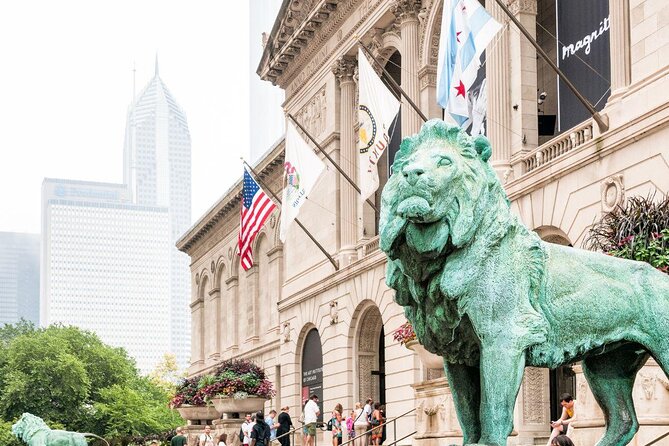
You start at the Art Institute area, where the clue set focuses on the museum’s founding as both a museum and a school for fine arts back in 1879. The story tie-in is the moment right after the Great Fire of 1871, when Chicago was rebuilding and civic energies were pouring into new institutions.
What I like about this start: it gives you context fast. Before you even reach the outdoor sculptures, the game nudges you to think about why Chicago invests in art in the first place. When you look at the surrounding buildings later, the city feels less like a backdrop and more like a place with a plan.
Practical tip: take a minute to scan your surroundings before you move. Clue hunts go faster when you are oriented first.
Explore Chicago on your own clock
- Medieval Torture Museum Ticket with Audio Guide and Ghost Hunting★ 5.0 · 962 reviews
- Chicago Self-Guided Audio Tour★ 4.0 · 9 reviews
- Chicago’s Gold Coast Hidden History: A Self-Guided Audio Walk★ 4.5 · 7 reviews
- Chicago Riverwalk Self-Guided Walking Tour★ 4.0 · 6 reviews
- Chicago Millennium Park Self-Guided Walking Tour★ 4.5 · 5 reviews
2) Calder’s Flying Dragon, stainless steel with red-orange energy
Next comes a spotlight on Alexander Calder (1898–1976) and his work in Chicago. The clue is tied to the Flying Dragon, a stainless steel sculpture coated in Calder’s signature red-orange color. The prompt also points you toward how Calder’s public art spans decades, with a note about his giant Flamingo in Chicago’s Federal Court Plaza.
Why this stop works in a game: Calder’s style is visual. You are not being asked to interpret a tiny plaque from ten feet away. You can walk around and use the sculpture’s shape and color to anchor your attention, then answer the challenge.
Watch-out: if the angle you are standing at blocks your view, you might need to reposition. Give yourself a little extra time here.
3) Crown Fountain, Jaume Plensa’s interactive video sculpture
Then the game shifts to Crown Fountain, an interactive work of public art and video sculpture in Millennium Park. It is credited to Spanish artist Jaume Plensa and architects Krueck and Sexton Architects, and it opened in July 2004.
The clue prompt makes you look closely, and that’s the point. Crown Fountain is not just something to photograph quickly. It is a public media sculpture, so the “story behind it” is partly about how people use it, not only what it looks like.
Practical tip: bring patience for crowds. Even if the tour is private, Millennium Park can still feel busy around iconic moments. If you want photos, plan for a second pass, or go slightly off-peak.
4) Cloud Gate, Anish Kapoor’s reflective 110-ton sculpture
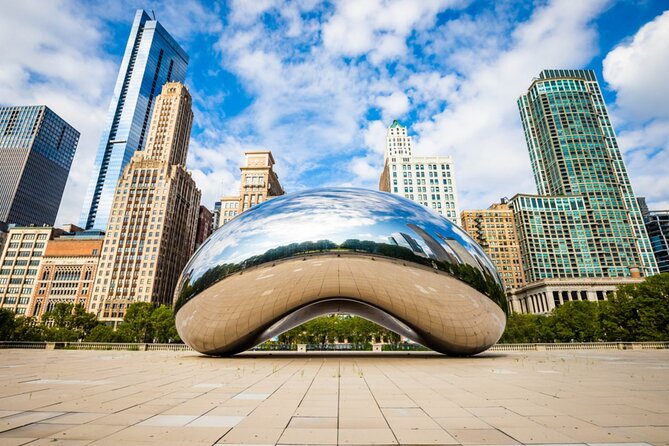
Next is Cloud Gate, the 110-ton elliptical sculpture by British artist Anish Kapoor. The game focuses on the fact that it is his first public outdoor work installed in the United States, made of seamless highly polished stainless steel plates. Your viewing payoff is the way it reflects Chicago’s skyline and the clouds above.
This is where you naturally slow down, because Cloud Gate basically asks you to play. The game challenge pushes you to notice reflections and details you might otherwise ignore. It is also the kind of place where you can walk a circle and spot different distortions in the skyline.
One practical consideration: this is a highly recognizable icon, so expect people moving in and out of your shot. If you want a clean view for the clue, step aside and let the flow reset.
5) Wrigley Square and the Millennium Monument replica
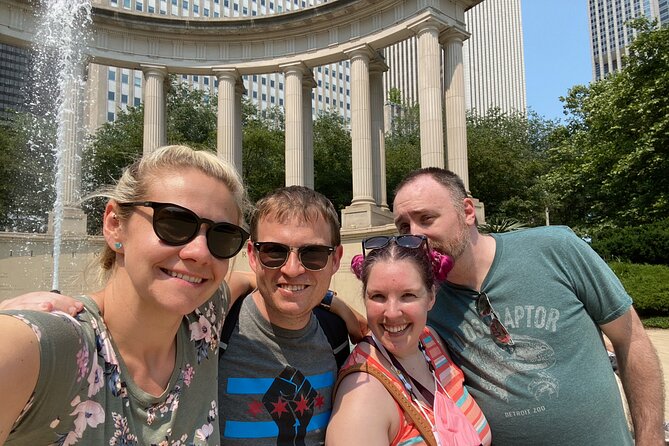
The game moves to Wrigley Square, where you learn about the Millennium Monument: a nearly full-sized replica of a Roman Doric-style peristyle, paired columns that originally sat in Grant Park near Michigan Avenue and Randolph Street between 1917 and 1953. The square also includes a large lawn and a public fountain.
What makes this stop interesting in a game setting is the contrast. After futuristic stainless steel and video art, this one lands on classical form and a sense of what used to be there. The clue helps you see it as a deliberate reconstruction, not random ornament.
Practical tip: if you want the columns from the best angle, look for a position that lines up with the arc of the peristyle. Then use that viewpoint to answer.
6) Lurie Garden, layered on top of Chicago’s buried past
Next is Lurie Garden, described in the prompt as being filled and framed, mostly with rubble tied to the Great Fire, then built up on the rooftop of a parking garage. The point is that the garden tells a layered story of what is buried beneath it.
This stop is subtle, which is exactly why it’s good for a game. You are likely to walk past a landscaped area if there is no reason to stop. Here, the clue makes you pause and connect the garden to a specific urban timeline.
One practical drawback to note: rooftop and planted areas can vary in accessibility depending on pathways and crowd flow. Move calmly and use your phone at a comfortable pace.
7) The Chicago Stock Exchange Arch, a surviving fragment
The game then highlights the Chicago Stock Exchange Arch, described as one of the few surviving fragments from the Chicago Stock Exchange building designed in 1893. It is installed outside the Art Institute of Chicago in Illinois.
This is a “look closer” stop. An arch fragment is easy to overlook if you are only hunting for the biggest names. The clue helps you treat it like a historical artifact, a real physical remnant rather than a generic downtown structure.
Practical tip: scan the arch area for the details the prompt asks for. If you cannot find it quickly, do a slow circle rather than guessing.
8) Buckingham Fountain, a 1927 landmark fountain moment
Now you hit Buckingham Fountain, a Chicago Landmark in the center of Grant Park near Queen’s Landing and Congress Parkway. It was dedicated in 1927 and is described as one of the largest fountains in the world.
This is an outdoor “big show” stop. Even if you have seen it in photos, the scale hits in person. The clue encourages you to look past the overall wow factor and tie it to why it is significant as a landmark.
Practical consideration: fountains can create tricky range and angle issues for location-based games. If the game expects you to be within a specific spot, plan to step around rather than standing still, and keep an eye on where you are allowed to walk.
9) A contemplative Lincoln sculpture in Solti Garden
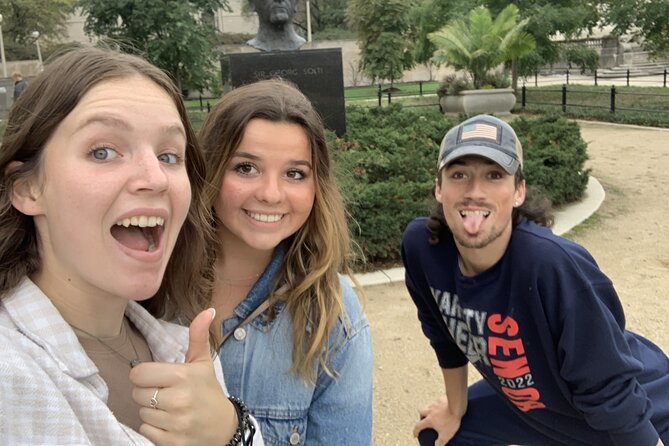
After Buckingham Fountain, the route includes a sculpture described as depicting a contemplative Lincoln seated in a chair, gazing down into the distance. The prompt notes it was moved to Grant Park and rededicated in October 2006 in the Sir Georg Solti Garden, near Symphony Center.
This stop is for people who like human-scale art in public space. Lincoln sitting and looking downward gives the sculpture a quiet tone, which can be a welcome break from the more visually loud icons like Cloud Gate.
Practical tip: give yourself a little extra time at this one. If you rush, you can miss the sculpture’s posture and lose the visual cue the game is going after.
10) Taft’s Fountain of the Great Lakes, Benjamin F. Ferguson Fund context
Next comes Taft’s Fountain of the Great Lakes, described as completed in 1913 and the first commission of the Benjamin F. Ferguson Fund, established to foster statuary and monuments along boulevards and other public places in Chicago.
This clue ties the fountain to civic planning and patronage, not just water. It is a useful reminder that many of Chicago’s public artworks were placed with intent: they were meant to shape how people move through the city.
Practical consideration: since the game is location-based, keep your phone handy and avoid wandering too far from the spot while you read the clue prompt.
11) Pritzker Military Museum & Library, founded in 2003
The route then includes the Pritzker Military Museum & Library, described as a non-profit museum and research library for the study of military history on Michigan Avenue. It was founded in 2003, and the prompt mentions specialist collections including material related to Winston Churchill and war-related sheet music.
This is a different flavor than the fountain-heavy portion of the route. It adds a straight narrative element about collections and research, so it breaks up the visual repetition of sculptures.
Practical tip: treat this as a stop where you learn a bit, not as something you need to fully explore. The game framing suggests a quick clue connection rather than a long museum visit.
12) School of the Art Institute of Chicago, founded 1866, building opened 1870
Finally, the game mentions the School of the Art Institute of Chicago (SAIC). It says SAIC was founded in 1866 by 35 artists, originally called the Chicago Academy of Design. It notes early success led to a building that opened on November 22, 1870.
This ending brings you full circle back to why Chicago takes art seriously. You started with the Art Institute’s 1879 founding story, and you end with the school’s 19th-century roots. The structure works because it links street-level landmarks with the institutions that train artists and shape the city’s creative output.
If you still have energy after the final clue, you can naturally continue onward toward Symphony Center or Michigan Avenue, since the route keeps you in that core downtown corridor.
Walking comfort, timing, and how to keep the game fun

Here’s the simple way to keep this experience smooth. Wear comfortable shoes, and plan for extra time at stops that you love. This is not just a route, it is a sequence of “look, find, answer, move.”
On timing: the duration is listed at about 1 hour 35 minutes. In real life, your pace will depend on how often you stop to read, how many photos you want, and whether you hit any construction detours. If you are starting late in the day, give yourself a buffer so you do not feel rushed.
One more practical move: keep your phone charged. The game is offline, but you still need power. Add a portable charger if you are also texting, mapping, or taking lots of pictures.
Who this is best for (and who should look elsewhere)

This works well if you want a playful, self-guided way to see Millennium Park and nearby landmarks without committing to a full museum day. It is also a solid fit for families and friend groups because you can pause, regroup, and keep going without the pressure of a live guide.
It may be less ideal if you hate location-based games, or if your group prefers a very scripted route with minimal phone reliance. Construction barriers and required “be close to the spot” moments can frustrate people who want everything to feel effortless.
It is also a good match for solo walkers who like learning while they move. You can start anytime, play offline, and avoid human contact, which can make the whole day feel calmer.
Should you book this Millennium Park heist game?

If you want a low-cost way to structure a landmark walk and you are comfortable using your phone to guide you, this is an easy yes. The best part is that it connects famous icons like Cloud Gate and Crown Fountain to short, story-driven prompts, while staying flexible enough for breaks.
If you are booking a day where construction detours would be a deal breaker, or if you are traveling with limited patience for any “range” issues, consider this a cautious maybe. The route is strong, but the game depends on you reaching the right spots.
FAQ
How long does the Eastside Chicago The Heist Exploration Game and Tour take?
It takes about 1 hour 35 minutes (approximately).
Can I play this game without an internet connection?
Yes. The tour is designed to play offline, so you do not need an internet connection to enjoy the city game.
Do I need a physical tour guide?
No. This is a private, smartphone-based experience with no physical tour guide and no human contact.
Where does the tour start and end?
It starts at 111 S Michigan Ave, Chicago, IL 60603, USA, and it ends at Fountain of the Great Lakes, E Jackson Blvd, Chicago, IL 60603, USA.
Is it private or shared with other groups?
It is a private tour or activity, so only your group participates.
What language is the game offered in?
The tour is offered in English.
What is the cancellation policy?
You can cancel for a full refund up to 24 hours in advance of the experience start time. If you cancel less than 24 hours before the start time, the amount paid is not refunded.
Just Added






Scavenger Hunts, compared.



Chicago Scavenger Hunt and Highlights Self Guided Audio Tour
Read our review →
Adventurous Scavenger Hunt in Chicago by Zombie Scavengers
Read our review →
Magnificent Mile Scavenger Hunt: Chicago Walking Tour and Game
Read our review →
Browse the lists this tour appears in