
Reviewed · WALKING TOURS
Downtown Chicago Guided Walking Tour Semi-Private 12ppl Max
Chicago’s best art lesson is outside. This 2.5-hour Downtown Chicago guided walking tour strings together major works in a compact Loop route, with a guide who explains how they fit into the city’s story. It is also timed so you get real time at each stop, not a “wave and rush” kind of tour.
What I like most is the small-group feel, capped at 12 guests, so questions do not get lost in the crowd. I also like that your guide is Mandy, who is described as flexible for people who need to leave early and very strong on tying the art to museum-level context.
One consideration: this is a moderate physical fitness walk in Chicago, and you are outside for much of it. Wear comfy shoes and be ready for the weather.
In This Review
- Quick hits before you go
- Getting started on the Chicago Loop
- Crown Fountain by Jaume Plensa, your first big impression
- The Bean, Cloud Gate by Anish Kapoor
- Muddy Waters Mural by Eduardo Kobra
- The Picasso: Pablo Picasso’s Untitled
- Miro’s Chicago: Joan Miro’s Chicago
- Calder’s Flamingo by Alexander Calder
- Chagall’s Four Seasons by Marc Chagall
- Clarence F. Buckingham Fountain by Marcel Francois Loyau
- Why eight stops works better than a museum day
- Price and value, is $51.94 a good deal?
- Logistics that actually matter for you
- Who this semi-private art walk is for
- Should you book this Downtown Chicago guided walking tour?
- FAQ
- How long is the Downtown Chicago guided walking tour?
- What is the maximum group size?
- Are there admission fees for the stops?
- Where do I meet, and where does the tour end?
- What fitness level do I need?
- Can I cancel and get a full refund?
Quick hits before you go
- Small group, max 12 keeps the pace human and questions easier.
- Guide Mandy is praised for art know-how and calm flexibility if someone needs to exit early.
- Eight major public-art stops with about 15 minutes each.
- Most stops are free to enter, so you are paying for interpretation and the guided route.
- Mobile ticket check-in helps you avoid extra steps.
- Chicago Loop location makes the walk feel efficient, not endless.
A few more ways to spend a day in Chicago
Getting started on the Chicago Loop
The tour starts in the Chicago Loop area (Chicago, IL 60603) and ends in downtown Chicago. That is ideal if you want to keep most of your time in one central zone, especially if this is your first day in town or you want a “downtown orientation” that is more interesting than just looking at buildings.
You get a mobile ticket, which is great if you are already juggling transit tickets, reservations, and photos. The tour is offered in English, and it is described as a skip-the-line guided walking tour, which matters because even when the art is outdoors, you still want the guide to keep you moving smoothly.
Crown Fountain by Jaume Plensa, your first big impression
The walk begins at Crown Fountain, a public artwork by Jaume Plensa. You get around 15 minutes here, and that is a good chunk of time for something like this, where the details are part of the point.
What makes this stop especially useful on a guided format is the way it sets the theme for the rest of the route. The tour frames downtown not only as architecture, but as a place where famous artists left their mark in public space. In other words, you are not just seeing a name, you are learning why this kind of art belongs in a city district.
Potential drawback: at the beginning of a tour, it is easy to rush your photos because you are still learning the group rhythm. If you are the type who likes to linger, give yourself a little extra time here, then match the pace at the next stops.
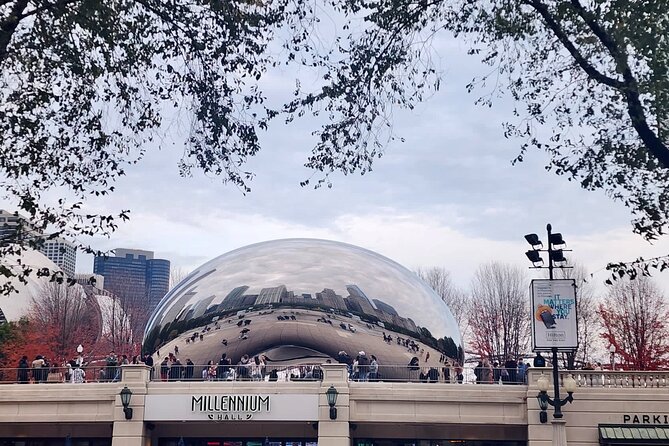
The Bean, Cloud Gate by Anish Kapoor
Next up is The big bean Chicago, which refers to Anish Kapoor’s Cloud Gate, also known as The Bean. You get another 15-minute stop, and admission is free, so the value is less about tickets and more about what the guide helps you notice.
This stop works well for two reasons. First, it is one of the most recognizable public-art landmarks in downtown, which makes it easy to “get” why people come. Second, it continues the tour’s emphasis on twentieth-century to contemporary creativity living right inside daily city life.
Possible consideration: this kind of world-famous public artwork can be busy depending on the time of day. A guided group helps you avoid standing around wondering where to look and when to move on, but you still may want to plan for crowds.
Muddy Waters Mural by Eduardo Kobra
At Muddy Waters Mural you see Eduardo Kobra’s Muddy Waters, again with about 15 minutes on the clock. This is one of the stops where the tour theme feels especially grounded, because it shifts from the “iconic landmark” vibe into something that feels like it belongs to Chicago identity and storytelling.
I like that the tour keeps repeating the idea that you can find world-class art hiding in plain sight, not just behind museum walls. This mural stop is a good example of how public art can connect the city to music, memory, and community, without needing you to understand everything instantly.
Practical note: murals and outdoor art can be harder to view in certain angles. Give the guide a second to point you to the best viewing side, then take your time from there.
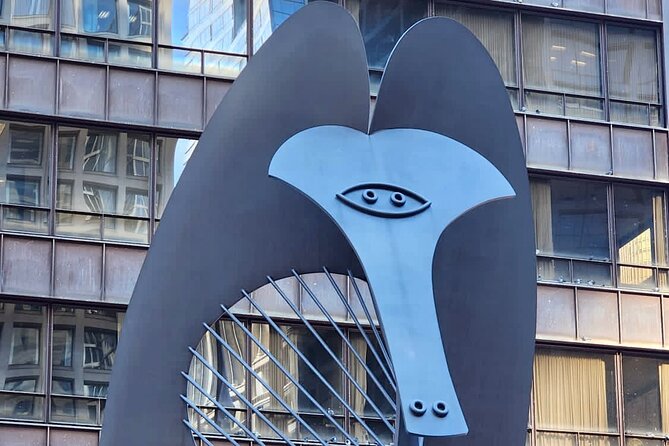
The Picasso: Pablo Picasso’s Untitled
Then you walk to The Picasso, featuring Pablo Picasso’s Untitled. You still get about 15 minutes, and admission remains free, which keeps the experience accessible. The guide’s job here is to help you read the work in context, not just identify the artist name.
One thing I appreciate about tours like this is that they treat public art like a serious part of the city, not a side quest. By placing Picasso close to works by other major modern artists, the tour encourages you to see patterns across styles and eras rather than treating each stop as a one-off photo op.
Possible drawback: Picasso can feel abstract, and with only a short visit, you might not feel like you solved it. That is not a failure, it is the design of the format. The guide helps you build a first interpretation quickly, then you can choose to look longer after the tour if you want.
Beyond the skyline, the neighborhoods have their own tours and their own stories.
- Chicago Architecture River Cruise★ 5.0 · 15,756 reviews
- Chicago River 90-Minute Architecture Tour★ 4.5 · 9,629 reviews
- Chicago River: 1.5-Hour Guided Architecture Cruise★ 4.8 · 8,046 reviews
- Chicago Architecture Center River Cruise aboard First Lady★ 5.0 · 5,536 reviews
- Chicago: Willis Tower Skydeck and The Ledge Ticket★ 4.6 · 4,350 reviews
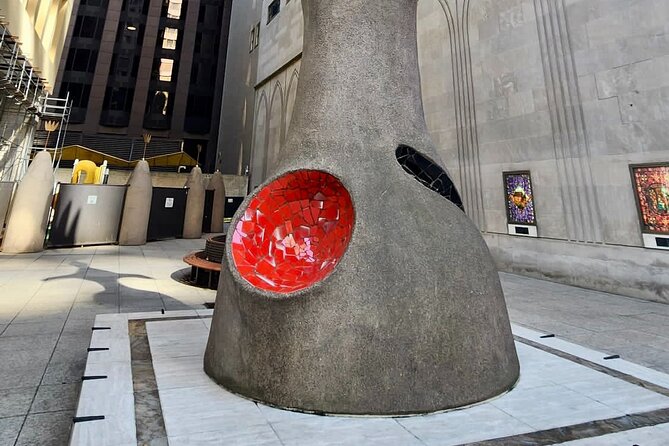
Miro’s Chicago: Joan Miro’s Chicago
Next is Miro’s Chicago, a public artwork by Joan Miro titled Chicago. Another 15-minute visit gives you time to focus on how the work sits in its downtown setting.
What I like here is the “conversation” effect created by the order of stops. You are seeing multiple heavyweight names in a walkable sequence, so you can start noticing how different artists respond to place, space, and the idea of a city itself. The tour language also frames this as part of Chicago’s larger rebuilding story, where the city’s downtown took shape after the Great Chicago Fire.
Consideration: if you are visiting on a tight schedule and you want to maximize “big targets,” Miro’s Chicago is still worth it, but it may not feel as instantly recognizable as some other stops. Lean into the guide’s explanation so you get the most out of the short time.
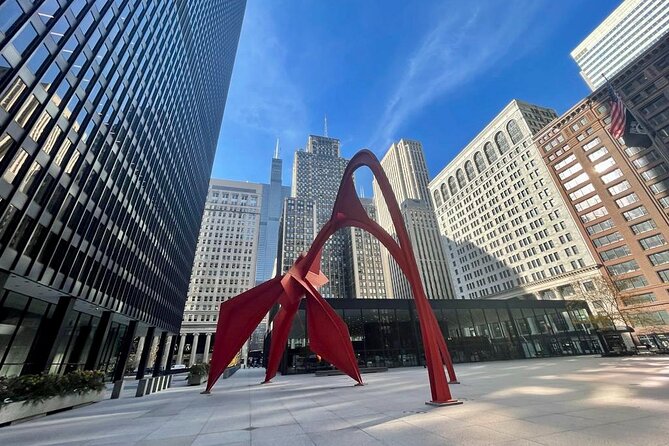
Calder’s Flamingo by Alexander Calder
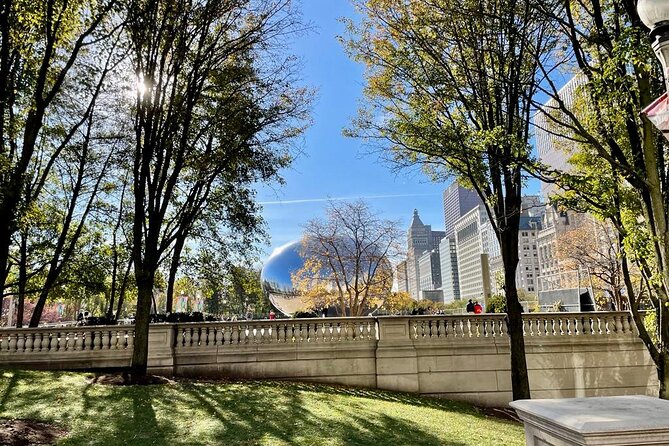
At Calder’s Flamingo, you see Alexander Calder’s Flamingo. You get about 15 minutes and the stop is free to access.
Calder is a smart inclusion for a walking tour because it adds a shift in energy. After a series of murals, icons, and painterly names, a Calder work tends to make you look at form and presence in a different way. Even without getting overly technical, it helps you understand why public art is not only about imagery, it is about how objects behave in open space.
Practical tip: if you want photos that look good, spend the first minute just observing how people naturally surround the work. Then position yourself where you can see the full piece without blocking other folks and without losing your own view.
Chagall’s Four Seasons by Marc Chagall
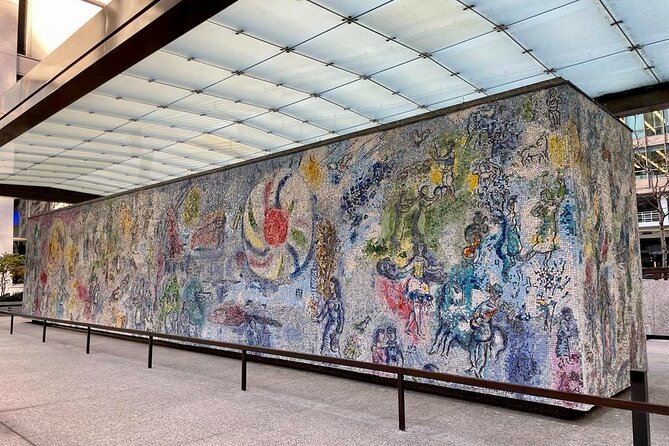
Next is Chagall’s Four Seasons, featuring Marc Chagall’s Four Seasons. You stay for around 15 minutes, with free access, and you keep moving through downtown at a pace that feels purposeful.
This is where the tour’s theme really pays off. The tour repeatedly connects major artists across decades, including the ones highlighted in its framing, like Picasso, Chagall, Miro, and Kapoor. By the time you reach Chagall, you are not just collecting names, you are building a map of how modern art sits inside Chicago’s public spaces.
Possible drawback: if you are easily tired by continuous standing, this is the point where you may feel it. Pace yourself, take a short break if you need it, and use your guide’s timing as a cue.
Clarence F. Buckingham Fountain by Marcel Francois Loyau
The last major stop is Clarence F. Buckingham Fountain, tied to Marcel Francois Loyau. You get one more 15-minute window to land the tour with something strongly associated with Chicago.
I like ending here because the tour started with the idea that downtown has more than architecture and more than museums. The fountain finish gives you a public, city-atmosphere moment to close on, where the artwork and the open space feel like one experience. You also end with a recognizable downtown anchor, which makes it easier to keep moving after the tour.
Consideration: depending on the season and the way the fountain area is set up, you might want to dress for lingering outdoors. Bring layers if the forecast swings, since the tour does not mention any indoor cover.
Why eight stops works better than a museum day
This tour’s strength is how it teaches you to see downtown as a canvas. The framing emphasizes how the Chicago Fire created a clean slate for rebuilding downtown during the gilded age. Then it argues that architecture grabs the headlines, while public art adds depth and character that you miss if you only do the skyline route.
That is a useful lens for you. Instead of collecting art facts, you learn a way of walking through a city: notice what is placed intentionally in public space, who created it, and why a downtown planner would want art there.
The second reason the format works is time. Each stop is about 15 minutes, and the whole tour is 2 hours 30 minutes. That is long enough for basic interpretation, short enough that you stay fresh, and structured enough that you do not feel like you are wandering.
Price and value, is $51.94 a good deal?
At $51.94 per person, this is not a free-to-attend stroll, but it is also not priced like a museum ticket day. Since each stop notes admission ticket free, you are paying mainly for the guided route, the “skip-the-line” flow, and the guide’s interpretation.
For me, the best value signals are the ones that reduce wasted time: a small group size, a guided pace, and a guide who knows how to explain art without making you feel lost. When a guide is praised for being flexible, it also suggests the tour avoids that rigid, keep everyone moving at all costs attitude.
If your goal is purely photos, you could technically do parts on your own. But if you want Chicago art to make sense fast, the guided approach is where your money goes.
Logistics that actually matter for you
This is a walking tour, so start with practical choices. The tour notes moderate physical fitness, and it also indicates it is near public transportation. You will likely want to plan your day around transit access so you are not burning energy just getting to the start point.
You also should plan for no food included. That sounds basic, but it matters in practice: if you go in hungry, the tour length can feel longer. Bring water if you like, and have a snack plan before or after since food and drinks are not included.
The tour does not include hotel pickup or drop-off, and Uber or taxi is recommended. That is helpful if your hotel is not close to the Loop.
Who this semi-private art walk is for
This is a good fit if you want a downtown-focused art experience without committing to a full museum day. I also think it suits first-time Chicago visitors, because the route gives you a fast introduction to the idea that Chicago’s public art is a core part of its identity.
It is also a good choice for couples and small groups who want the energy of a guided tour but do not want the crush of a large group. With a max of 12 travelers, it stays semi-private in a way that makes conversations realistic.
If you are traveling solo, it can be a confidence boost because you are not navigating between eight stops alone. And if you are someone who likes art but finds big lectures intimidating, this format is short, visual, and guided.
Should you book this Downtown Chicago guided walking tour?
I’d book it if your ideal Chicago day is about seeing major public artworks in a smart order and getting an explanation you can carry forward as you explore. The biggest reasons are the small group cap and the fact that your guide is specifically praised for being flexible and knowledgeable about art and museum context.
I would hesitate only if you hate walking outside for long stretches or if weather is likely to be rough. This tour seems designed for comfortable movement through the Loop, not for indoor comfort.
If you want a first-pass guide to Chicago’s public art scene, this is a strong way to do it. And since it is commonly booked far in advance, grabbing a slot early is the smart move.
FAQ
How long is the Downtown Chicago guided walking tour?
The tour is listed at about 2 hours 30 minutes.
What is the maximum group size?
The tour is semi-private with a maximum of 12 travelers.
Are there admission fees for the stops?
The stops listed show admission ticket free, so you are not paying separate entry fees at each artwork location.
Where do I meet, and where does the tour end?
The meeting point is in the Chicago Loop area (Chicago, IL 60603), and the tour ends in downtown Chicago.
What fitness level do I need?
The tour notes that travelers should have a moderate physical fitness level.
Can I cancel and get a full refund?
Yes, you can cancel up to 24 hours in advance for a full refund. If you cancel less than 24 hours before the start time, the amount paid is not refunded.
Just Added





Walking Tours, compared.

Chicago Favorites Ultimate Food and Walking Tour
Read our review →
Chicago in a Day: Food, History & Architecture Walking Tour
Read our review →
Chicago’s Secret Interiors Architectural Walking Tour
Read our review →
Browse the lists this tour appears in