
Reviewed · ARCHITECTURE TOURS
3 Hours Chicago Architecture Tour – Skyscrapers and Photo Ops
Chicago skyline joy starts with a camera. This small-group architecture tour strings together standout downtown buildings and gives you timed photo stops at major icons like the Rookery Building and the world’s largest Tiffany dome. I love that the pace stays human for a 3.5-hour outing, and I also like that the guide ties each stop to the bigger Chicago story instead of just pointing at pretty faces. One thing to consider: it is a lot of walking plus a short train hop, so plan on comfy shoes and a moderate fitness level.
At $135 per person, it is not a bargain, but it is priced like a focused city experience with a friendly local guide, small group size (up to 10), and included transit tickets. Bonus: several stops are free to enter, so your money goes mostly to interpretation, timing, and getting you to the best angles. The only watch-out I see is that the itinerary depends on the guide being available, and I did see a case where the tour was cancelled due to the guide getting sick, though a full refund was provided.
In This Review
- Key things to know before you go
- A 3.5-hour architecture walk with a quick Chicago L shortcut
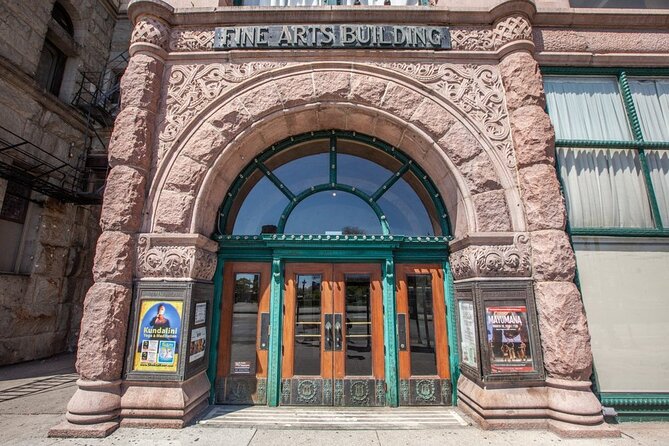
- Fine Arts Building: Studebaker roots, artist-era façade details
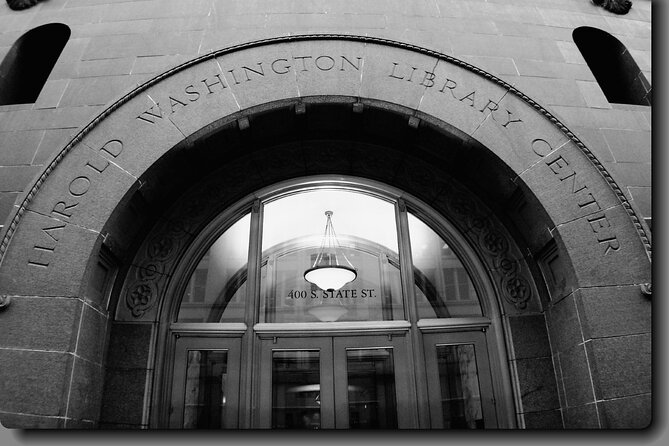
- Harold Washington Library Center rooftop sculptures and rare book details
- Monadnock and Marquette: early skyscraper ambition in brick and ornament
- Revival Food Hall for a reset, then the Rookery’s engineering leap
- Quincy station and the Chicago L hop to the final landmarks
- Macy’s on State Street: look up for elevators and glass mosaic ceiling
- Chicago Cultural Center: the Tiffany glass mosaic dome finale
- Price and value: what $135 buys you, and how to get the best out of it
- Who should book this tour, and who should skip it
- Should you book this Chicago skyscraper photo ops tour?
- FAQ
- Where does the tour start?
- Where does the tour end?
- What time does the tour begin?
- How long is the tour?
- How big is the group?
- What language is the tour offered in?
- Is public transportation included?
- Are tickets and fees included in the price?
- What cancellation options are available?
- What fitness level do I need?
Key things to know before you go
- Small group size (max 10) keeps it easier to hear details and get better photo time.
- Photo-forward downtown stops include the Fine Arts Building, the Rookery, Macy’s, and the Chicago Cultural Center.
- A short CTA L ride from Quincy station helps you reach the last two landmarks quickly.
- Several major interiors and exteriors are free to access on the schedule, so you pay for the guide and structure.
- Downtown architecture timeline in one route runs from late 1800s masterpieces to later public icons.
- Best for guided structure if you want the stories behind the façades and engineering, not just snapshots.
Chicago's skyline, explained block by block
A 3.5-hour architecture walk with a quick Chicago L shortcut
This is a 3 hours 30 minutes downtown-focused tour that starts at the Fine Arts Building (410 S Michigan Ave) at 10:00 am and finishes at the Chicago Cultural Center (78 E Washington St). Most of the time is spent walking, with one smart break in the middle using the Chicago L to connect you to the final stops without losing half your day to transit confusion.
You go with a friendly local guide in English, and the group stays small, up to 10 travelers. That matters in Chicago because the Loop can get crowded, and close-in buildings mean you often need a clear spot to photograph details like terra cotta ornamentation or glass mosaics.
If you want the best value from this kind of tour, come in ready to look up. The itinerary is built around exterior details first, then a few interior-style moments where you can appreciate ceilings, domes, and landmark finishes.
Fine Arts Building: Studebaker roots, artist-era façade details
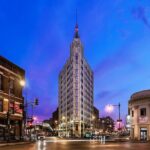
Your first stop is the Fine Arts Building, a Chicago architectural jewel designed in 1885 by Solon S. Beman. Construction took about two years, and the building gained a famous reputation early for its design and craftsmanship. You also get a key piece of context: it was originally built for the Studebaker company, then renovated and renamed as the Fine Arts Building in 1898.
I like this start because it sets the tone for what you will keep seeing later: Chicago buildings are not just tall, they are built with intentions, and the façades often tell you what the city wanted at the time. Use the roughly 20 minutes at this stop to study the stone and ornament patterns, not only the overall shape.
Possible downside: because this is a quick first stop, you will want your camera ready right away. If you spend the whole 20 minutes re-positioning, you might miss the best façade angles your guide is pointing out.
Harold Washington Library Center rooftop sculptures and rare book details
Next comes the Harold Washington Library Center, where you spend about 30 minutes soaking in one of the most distinctive silhouettes in the Loop. The rooftop features Gothic-style sculptures that separate it visually from many neighboring buildings.
This stop is also about story. The library was named after the first African-American Chicago mayor, and it opened to the public in 1991. Inside, the library holds a large number of rare books arranged by period, and the building earned a place in the Guinness Book as the largest public library building.
What I find practical here: libraries tend to make people think of quiet rooms, but the architecture tour angle puts the focus on what makes the exterior and the roofline memorable. For photos, the rooftop theme gives you strong shapes and contrast, so it is a good place to practice clean framing on your phone or camera.
Monadnock and Marquette: early skyscraper ambition in brick and ornament
Two of the most “Chicago” building lessons happen back-to-back here, and both are worth the quick 20 to 30 minute windows you get.
First, the Monadnock Building is tied to the early skyscraper era but still follows traditional brick logic. You see a strict, almost monolithic design, and the building’s name connects to Mount Monadnock in southern New Hampshire. Even the word monadnock has a meaning used by American geographers for a rocky mass, so the nickname makes visual sense if you look at the façade like a solid block with weight.
Then you head to the Marquette Building, built during Chicago’s 19th-century building boom. The big idea your guide explains is that rapid city growth created a demand for high-rises that could actually pay off economically. On the surface, that economic push shows up in decoration: terra cotta ornamentation, decorative bronze reliefs, and Tiffany mosaics.
This is one of the stops where I’d treat the time as “look fast, then look twice.” Your guide’s story element matters here because you are not just admiring details, you are learning why those materials and motifs show up on a business-driven building.
Revival Food Hall for a reset, then the Rookery’s engineering leap
Between the heavier architecture stops, you get a breather at Revival Food Hall. This is a 24,000 square foot marketplace on the ground floor of The National Building, and it is designed around the idea of Chicago’s food scene under one roof. Your schedule gives you about 25 minutes, which is enough to grab something without turning the tour into a meal marathon.
The practical benefit is that this break helps you keep your energy up for the afternoon photo and interior-looking finale. You can choose from options like hamburgers, pizza, and Mexican food, so there is usually something that fits different tastes.
After the food stop, you go to the Rookery Building for about 20 minutes. This is one of those buildings that architecture fans talk about for a reason: it was the first skyscraper built using newer materials and engineering technologies, which helped shape the direction of tall buildings that followed. Completed in 1888 by Daniel Burnham and John Wellborn Root, it is described as one of their masterpiece buildings.
If you love photos, the Rookery stop is a strong candidate for your best “detail plus landmark” shot. If you only take one photo of the entire tour, this might be the one to aim for. Even in a short time, the building’s design cues make it easy to capture something unmistakably Chicago.
A few more ways to spend a day in Chicago
- Chicago: 3-Hour Private Speakeasy Cocktail VIP Tour★ 5.0 · 7 reviews
- Chicago: Private 3-Hour Al Capone Gangster Tour★ 4.8 · 9 reviews
Quincy station and the Chicago L hop to the final landmarks
In the middle of the tour, you take the Chicago L from Quincy station to reach the last two stops. Your time here is about 20 minutes, and the station is significant because it opened in 1897, making it one of the oldest surviving stations on the L system.
Renovations in 1988 preserved the station’s original look, which helps the ride feel more like transportation history than a modern rebuild. Also, using the L in the middle of a walking architecture route is smart. You save time, you avoid unnecessary street navigation, and you keep the whole outing within a reasonable half-day block.
Worth noting: this portion uses public transit, so be ready for the reality of city noise and crowds. It is still part of the experience, just not the quietest moment for photos.
Macy’s on State Street: look up for elevators and glass mosaic ceiling
Your next stop is Macy’s on State Street, scheduled for about 25 minutes. This is an iconic Chicago Loop department store and a true architectural monument of the 20th century, at least in terms of visual impact inside the city core.
What you should plan to do at Macy’s is very simple: look up. Your tour time focuses on architectural features, including old elevators that are displayed like museum pieces. Then there is the ceiling, with a glass mosaic that is a standout for anyone who likes geometric patterns and light effects.
This is also a practical moment because you can shop if you want. But even if shopping is not your goal, the building itself gives you something to do besides walking: standing still and studying the interior surfaces.
A possible drawback: department stores can feel crowded depending on the time of day. If you want the cleanest photos, you may need a little patience while people pass through.
Chicago Cultural Center: the Tiffany glass mosaic dome finale
The tour culminates at the Chicago Cultural Center for about 15 minutes, and it is designed as a high-impact finish. Opened in 1897, the Cultural Center is the kind of building where you step inside and feel like the city just got more interesting.
The headline is the world’s largest Tiffany glass mosaic dome. You also get a chance to stroll through halls with impressive ceilings, ornaments, reliefs, and other decorative details. It is also a place where free music and art events happen, along with some official ceremonies, so it’s not only a pretty stop, it is part of Chicago’s active public life.
For your photos, treat this as your grand finale shot list. If you saved some extra battery and storage, this is where you will use it. The dome theme works especially well because you can frame it from different angles, even in a relatively short time.
Price and value: what $135 buys you, and how to get the best out of it
Let’s talk money. The price is $135 per person for about 3 hours 30 minutes, with all fees and taxes included. Included with the experience are a friendly local guide, a small-group walking tour, and transit tickets. Several scheduled stops are listed as free entry, so you are not paying admission for most of the highlights. You are paying for interpretation, timing, and a route that strings together the most photogenic and story-rich downtown buildings efficiently.
Is $135 worth it? For me, it is when you want more than landmark spotting. The itinerary is built around explanations that connect buildings across eras, like how Chicago’s economic growth shaped the idea of profitable high-rises, or how brick architecture could still play the role of skyscraper.
Also, small group size helps. Up to 10 people means you can ask questions and keep your attention on details. That improves the odds that you actually take away something, not just photos.
One extra real-world point: there is only a single documented cancellation case I saw where the tour was cancelled because the guide got sick, and the operator provided a full refund. That is not proof of how every day goes, but it does suggest they handled at least that situation professionally.
If you are sensitive to walking, this tour fits best if you have moderate stamina. The stops are frequent, but the total time and the inclusion of a train ride still mean you should plan for movement.
Who should book this tour, and who should skip it
This is a strong pick for you if you want a guided architecture route that is built for photo ops, not a long lecture. It is also ideal if you like the Chicago Loop at a human pace, where you can see how old buildings and public institutions share the same streets.
You might skip it if you prefer a totally self-guided day. The stops are meaningful, but the value here is the guide tying them together and the route keeping you efficient.
It also makes sense if you are traveling with only part-day time. Three and a half hours is a convenient block, and the L connection helps you see more without stretching the schedule.
Should you book this Chicago skyscraper photo ops tour?
If your goal is to see downtown Chicago’s architecture highlights with a plan, I’d book it. The route is concentrated, the photo stops make sense, and you end with a dramatic finish at the Cultural Center’s Tiffany dome.
If you are on a tight schedule, consider booking sooner since this tour is often booked about 56 days in advance. And if you hate walking, rethink it, because the outing is built as a small-group walking tour plus a short transit hop.
Overall, it is a practical half-day experience that treats architecture like something you can see, photograph, and understand in one run. Just go in ready to look up, because Chicago’s best details are rarely at eye level.
FAQ
Where does the tour start?
It starts at the Fine Arts Building, 410 S Michigan Ave, Chicago, IL 60605, USA.
Where does the tour end?
It ends at the Chicago Cultural Center, 78 E Washington St, Chicago, IL 60602, USA.
What time does the tour begin?
The start time is 10:00 am.
How long is the tour?
The duration is about 3 hours 30 minutes.
How big is the group?
The tour has a maximum of 10 travelers.
What language is the tour offered in?
The tour is offered in English.
Is public transportation included?
Yes. You ride the Chicago L train, starting from Quincy station, and transit tickets are included.
Are tickets and fees included in the price?
All fees and taxes are included. Most stops are listed as admission ticket free, and the Quincy station transit ticket is included.
What cancellation options are available?
You can cancel for free up to 24 hours in advance for a full refund. If you cancel less than 24 hours before the experience starts, the amount paid is not refunded.
What fitness level do I need?
You should have a moderate physical fitness level.
Just Added



Architecture Tours, compared.

Chicago Architecture Center River Cruise aboard First Lady
Read our review →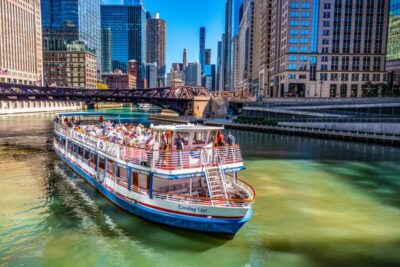
Architecture River Cruise Skip-the-Ticket Line
Read our review →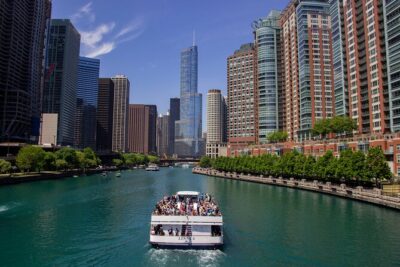
Chicago River 45-Minute Architecture Tour from Magnificent Mile
Read our review →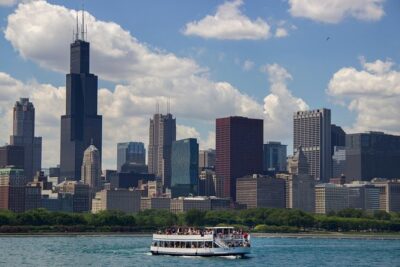
45-Minute Family-Friendly Architecture River Cruise
Read our review →Browse the lists this tour appears in